Showing posts with label Driving. Show all posts

2017 FORD FUSION HYBRID SE


  • Exterior Color: White
  • Engine: 2.0L IVCT ATKNSN CYCL I-4 HYBD
  • Transmission: TRANS: E-CVT AUTO 
  • Mileage: 19,968 
  • VIN: 3FA6P0LU9HR182917 
  • Stock Number: C425

Larry Jay Mitsubishi has a wide variety of used and new vehicles. For more information on this 2017 Ford Fusion Hybrid, give us a call at 704-551-6500 or view more details here!

Make Each Trip a Memorable One


In the city or the great outdoors, Outlander will take you there with advanced safety technology and 10-year, 100,000-mile powertrain limited warranty. View New Outlander models online here!

The Ultimate Tire Buying Guide: How to Buy the Right Tires

Buying new tires can be a confusing chore. What do all those numbers mean? Should I go with winter tires or all-season? And, of course, how do I know when I need new ones?
Taking care of your tires and maintaining good driving habits can help extend the life of your tires, but eventually you’ll need a new set. That’s why we’ve put together this comprehensive tire buying guide with all the information you’ll need to help make an informed choice. The first order of business: Know when your tires need to be replaced.

Do you need to buy new tires?

Vehicle manufacturers typically recommend that your tires be changed every six years, regardless of wear and tear. Check your owner’s manual to see what your car maker suggests.
Have a mechanic inspect your tires regularly for signs of wear or damage. You should also check them out regularly, as well. Look for the factors below:
  • Tread depth – Place a penny upside down into the treads or grooves. If you can clearly see Lincoln’s entire head, your treads are likely worn and it may be time to replace them.
  • Sidewall cracks – Check for cuts or deformations in the sidewalls. If you see any grooves, your tire could be on the verge of a leak.
  • Bulges or blisters – A noticeable bulge or blister could indicate a weak outer surface.
  • Vibration – Does your car vibrate noticeably when you’re driving? This could indicate problems now and potential danger down the road.
If you need new tires, buy the size and type specifically for your car. Mixing different tire types could not only cause damage, but could also be dangerous.

Buying the right tires

Tire terminology you should know

On the sidewall (the outer and inner sides) of a tire, you’ll find the following information:
  • Tire Specs – Size, construction and speed rating. Speed rating is the approximate speed a tire can safely maintain over time. The higher the rating (A is the lowest and Y is the highest), the better the handling and control. However, a higher speed rating may result in a shorter tread life. Check with your carmaker for the proper speed-rated tire for your model.
  • Department of Transportation Safety Code – This code certifies the tire manufacturer meets U.S. Department of Transportation tire safety standards. It is followed by your tire’s ID number, plus information about where and when the tire was manufactured.
  • Uniform Tire Quality Grading (UTQG) – The testing method used to grade a tire’s tread wear, traction and temperature.
  • Icons – Features a tire’s unique benefits. For example, “M+S” means the tire meets the Rubber Manufacturers Association standards for mud and snow.

How to read a tire’s sidewall

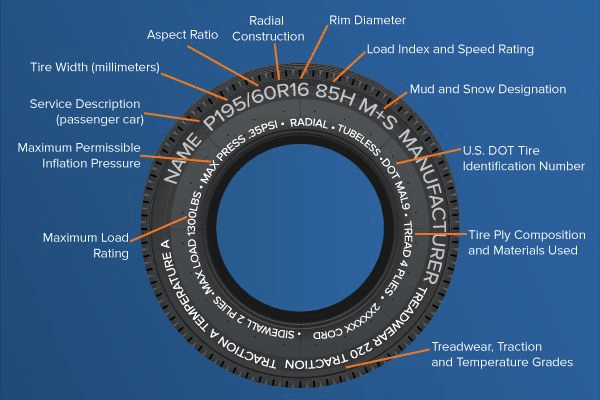
The diagram below shows where you’ll find this information on a tire.
How to read a tire's sidewall graphic
Note the code on the sample tire above is P195/60R16 85H. The table below shows what each abbreviation in the code means.
PService Description
P = “passenger car”LT= “light truck”ST = “special trailer”T = “temporary”
195Tire Width 
Tire’s section width – distance from sidewall edge to sidewall edge. The higher the number, the wider the tire.
60Aspect Ratio
Tire’s section height compared to its section width. Lower numbers mean a short sidewall with improved steering & handling.
RInternal Construction
R = radial construction
16Rim Diameter
Wheel diameter, in inches, for which the tire was sized.
85Load Index
Measurement of how much weight each tire is designed to support. The larger the number, the higher the load capacity.
HSpeed Rating
Speed the tire is designed to run for long periods.S = 112 mphT = 118 mphU = 124 mph
H = 130 mph
V = 149 mph
Z = Over 149 mph
W = 168 mph
Y = 186 mph
(Y) = Over 186 mph
Another factor to consider in buying tires is tread-life warranty– an estimate based on the type of tire and the number of miles it can be expected to travel under normal driving conditions.

Types of tires

Now that you know tire terminology, consider the type of tire best suited for you and your car.
Type of TireDescriptionSpeed RatingsTread-Wear Warranty (miles)Best For
All-season tiresCost-effective tires offer a smooth ride, long tread wear and adequate traction on dry and wet conditionsNone, S, T40,000 – 100,000Cars and minivans
Older cars & climates that rarely drop below freezing temps
Performance all-season tiresTypically offer better handling and braking than regular all-season tiresH, V40,000 – 60,000Cars & minivans
Newer cars
Ultra performance tiresProvide good handling and steering in wet and dry conditionsZR, W, Y30,000 – 40,000Cars & minivans
Upscale sedans or sports cars
Summer tiresThe softer rubber provides maximum traction on dry and wet roads in warmer weather  Cars & minivans
Warmer climates
All-terrain tiresBest for paved roads and light-duty, off-road useS40,000 – 60,000Light trucks & SUVs
Fit for most weather conditions – good for SUVs & other 4-wheel drive cars
Winter tiresTread is designed for snow and ice; rubber can withstand freezing tempsQ, S, TNoneAreas that experience wintry conditions
Performance winter tiresEnhanced winter traction offers high-speed handling and higher levels of snow and ice gripQ & upNoneAreas that receive an increased amount of snow and ice
When selecting tires, consider:
  • Weather conditions you commonly drive in
  • The worst weather situations you could expect to face
  • Where you usually drive – city streets, highways, etc.
  • Your driving style

Always make sure you select tires that are appropriate based on your owner’s manual and your tire distributor’s recommendation.
Here are some frequently asked questions about tires:

Common tire questions

What driving habits negatively impact a tire’s life?

  • Taking curves and corners fast
  • Abrupt accelerating and braking. This can cause excessive heat that wears the tire out more quickly
  • Hitting curbs, potholes, etc.

How do you extend the life of a tire?

In addition to driving responsibly, there are other ways you can prolong tire life:
  • Check wheel alignment as recommended by your carmaker

What is the correct air pressure for your tires?

Find your optimal operating tire inflation pressure in the owner’s manual and on a sticker located on the inside of the driver’s door.

Can you mix tire types?

Performance is best when all 4 tires are the same size, tread pattern and age. Tires that vary in those factors can cause handling and stability problems. However, some cars have different size tires in the front and rear, so check your owner’s manual.

Can you mix tires with different speed ratings?

Generally, not recommended. It could affect handling and maximum speed limit.

When should you use winter tires?

Winter tires are generally used when the temperature remains consistently near freezing. Winter tires can provide improved grip on icy and snowy surfaces, and are one way you can prepare your car for driving in the snow.

Should winter tires be used only in snow?

Usually, if temperatures drop and you’ll be driving in rain, ice, snow or other wintery conditions. When temperatures stay above freezing, change to summer or all-season tires. 

Can you use summer tires in the winter?

This is not usually recommended. Cold weather can cause softer summer tires to lose grip, develop cracks and shorten tire life.

Should you purchase used tires?

This is not typically recommended. You may be unaware of past hazards or mistreatment the tires underwent.
Choosing the right tires and knowing how to care for them is critical to safe driving. Get more tire safety tips, so you can keep yourself and your tires in top shape on the road.

2016 Dodge Charger R/T


Vehicle Details
  • Exterior Color: Pitch Black Clearcoat
  • Engine: ENG: 5.7L V8 HEMI MDS VVT
  • Transmission: Automatic
  • Mileage: 37,814
  • VIN: 2C3CDXCT1GH203411
  • Stock Number: C523

How to Clean Your Car Engine


Knowing how to clean your engine is an important part of vehicle maintenance, and it can save you money. Tidying up under the hood helps extend the life of belts, hoses and other components. Plus, it’s easier to spot leaks, tears and other damage on a clean engine. Check out the steps below to properly clean your car engine, and be sure to consult your car’s operation manual before you get started.

1. Eliminate any residue

Your car’s hood, grille and vents are prime areas for dirt buildup. Blow them out with compressed air or clean the areas with a wire hand brush.

2. Get the temperature just right

Next, let your engine warm up to a moderate temperature – not too hot. This will help soften grease buildup in the engine compartment.

3. Know what to cover when cleaning your engine

Plastic sandwich bags come in handy when it’s time to clean up your car. The parts to keep covered when cleaning your engine are:
  • Electrical wiring
  • Sensors
  • Spark plug openings
  • Alternator
  • Distributor
Secure the baggies with tape. To protect your battery, cover it or simply remove it.

4. Don’t forget the drip pan

Place old towels on an absorbent mat under the engine’s oil drip pan to catch any hazardous waste.

5. Give the engine a good spritz

Thoroughly spray the engine compartment with an engine cleaner, avoiding the wiring you bagged and taped. Since petroleum cleaners can damage rubber and vinyl components, consider a citrus or water-based degreaser. For parts that seem extremely oily or greasy, let the cleaner soak in for 15-30 minutes and repeat if necessary.

6. Rinse and unwrap

Once the engine cleaner has done its job, lightly rinse engine and components with water. Remove the bags you used to protect the wiring. Once the towel or mat is dry, dispose of it properly. And if you removed the battery, don’t forget to replace it.

7. Remove excess moisture

Blow away excess water in the engine compartment with compressed air.

8. Dry out the interior

Lastly, turn on your engine and let it run until warm. The heat will help dry the hard-to-reach areas.
Now that you know how to take care of your engine, check out our car maintenance checklist to help you keep your automobile in tip-top shape. But remember, protecting your vehicle isn’t just about regular inspections and cleaning schedules. Learn about how auto insurance works to keep you and your car safe on the road.

What Causes Tire Wear?


There are many factors that can cause tire wear, such as your driving style and tire maintenance habits. Tire replacement is absolutely needed when the tread wear indicators appear. Built-in tread wear indicators look like narrow strips of smooth rubber across the tread and become visible as the tire surface wears.

New 2018 Mitsubishi Mirage ES: Wine Red

2018 Mitsubishi Mirage ES


Internet Price: $13,025

  • Year: 2018
  • Make: Mitsubishi
  • Model: Mirage
  • Trim: ES
  • Exterior Color: Wine Red
  • Engine: 1.2L MIVEC DOHC 12-Valve 3-Cylinder
  • VIN: ML32A3HJXJH000825
  • Stock Number: 18001

Used 2016 Nissan Juke S

2016 Nissan Juke S


Internet Price: $15,821

  • Exterior Color: Maroon
  • Engine: 1.6L 16-Valve
  • DOHC I4 -inc: Direct Injection Gasoline (DIG) Turbo
  • Transmission: Variable
  • Mileage: 40,680
  • VIN: JN8AF5MV8GT659110
  • Stock Number: C493

How to Make Your Car Smarter

Connected automobiles are poised to become the norm. But these days, the smarter car, the more expensive it is. And not everyone is willing to break the bank just yet. 
Fortunately, modernizing your ride doesn’t have to be cause for fiscal toil. From pulling data about your car to anti-sleep apps, there are various ways you can make your old car smarter while being kind to your wallet.

Get on board with OBD

For decades, cars have had powerful computers that manage a kajillion digital processes. The system that helps report all this information to smog technicians and mechanics is the on-board diagnostics port (OBD).
Already pretty smart, right? But OBD ports have also made way for other devices that can make your car, well, smarter.

Cue the dongle

Dongles are adapters that plug into the OBD port, and many are designed to distill the car’s high-octane volume of data down to a simplified report for the driver.
Utilizing this data, some devices help estimate how much you spend on gas each month, or the fuel costs for a specific trip so passengers can easily (and, more important, equally) split fuel costs. Others let you know when it’s time to get an oil change or replace your brake pads.
Given that many of these devices have GPS, certain brands also provide roadside assistance. So information regarding the specific car troubles can be automatically broadcasted from the device to the tower.
Some top-brand dongles cost as low as $10 a month, plus a one-time equipment fee (not including taxes and such). Advanced diagnostics products can run upwards of $500 and into the thousands, but may still be more affordable than opting for even among the least expensive semi-autonomous car.
Now, you might be wondering about cars without OBD ports. Well, a device that can be found on restaurant tables across the U.S. also enables plenty of connected-car features: your smartphone.

Apply the apps

Got a souped-up ’73 Dodge Dart with candy paint but no OBD? Well, if you’ve got a smartphone, you may have access to a suite of connected-car apps that cost next to nothing (and sometimes nothing).

Combating drowsy driving

If you’re planning a long trip with your roadster and are worried about drowsy driving, several anti-sleep apps may be exactly what you’re looking for.
Some let you set up alarms beforehand, at random intervals, to help keep you awake throughout the trip. But many monitor drowsiness cues using complex algorithms, which detect head positioning and eye-blinking rate. When it spots drowsiness, an alarm goes off.
Considering that stats show nearly 17 percent of fatal crashes involved a drowsy driver, apps like these — which don’t cost much — can be absolutely vital.

Improved navigation

Sure, most smartphones are already equipped with interactive map systems. But if you want to take your navigation to the next level, check out the latest apps that turn your smartphone into a projector. In effect, they transform the lower portion of your windshield into a display screen so you never have to take your eyes off the road.
And they can even alert you to upcoming sharp turns through a combination of visual aids and voice assistant. Plus, some brands don’t require any extra projectors or special film for the windshield.

Lane-changing and collision-warning

Driving apps for smartphones often employ GPS, cameras, and sensors to alert the driver if, say, the car ahead has slammed on the brakes, using a variety of visual cues. While they’re not an absolute substitute for collision-warning systems, they may be able to identify hazards before the driver has time to react.
But even more advanced systems are available to vehicles, with or without OBD, that can either be hardwired into the vehicle or — if your car has one — co-opt the OBD. Products like these are designed to detect road markings, gauge vehicles ahead, and use unique alerts as part of their lane-departure and collision-warning systems.  Products like this typically cost around $500.

The Smart Driver’s Guide to Soaring Gas Prices

Industry experts are predicting that the days of cheap gas are over. (Tell us something we didn’t already know, experts.) In fact, MarketWatch says we may spend $52 billion (yep, with a “b”) more in the coming year than we did last year. That’s an average of $2.70/gallon, up from $2.13 in 2016.
Ok, that’s the bad news.
The good news? Well, the good news comes in the form of some ol’ fashioned smarts and a little high-tech intel. Because when it comes to saving money on gas, the more you know, the better.
Let’s start with the smarts.

Increasing your fuel efficiency: fact vs. myth


Whenever gas prices rise, we all tend to get a little — er, creative — when it comes to getting the most miles for the buck. But over the years, this creativity has led to some confusion around what actually works and what doesn’t.
To help get to the bottom of it all, we created this gas-saving, myth-busting quiz. Find out if you’re doing it right, or if there are other things you could do to save as much as possible on gas.
Even though we know that gas prices overall will rise in 2017, we also know that they’ll continue to go up and down from day to day as gas prices inexplicably (or complexly explicably) do.
But what if you could predict which days they’ll go up and which days they’ll go down? Imagine how much could you save.
Thankfully, we’ve got an answer. Cue the high-tech intel …

Meet Fuelcaster — the gas price predictor™


As the time of cheap gas comes to an end, Fuelcaster® is a modern-day hero that lets you know if prices are expected to rise or fall. That way, you can decide whether you should buy today or wait for better prices tomorrow.
It also lets you know which gas stations have the lowest prices in your area, so you can get the best possible deal every single time you fuel up.
You can access Fuelcaster on any device with an internet connection. It’s totally free and you don’t need to download anything to get started. Just enter your ZIP and let the magic happen. Get a gas price prediction now.
If you’re wondering how it all works, learn more about Fuelcaster here. (Hint: it’s a little magic and a lot of tech.) And as your modern-world insurance company, it’s all part of our ongoing commitment to helping you make informed decisions and save money too.
Happy saving, drivers!