Routine maintenanceon your vehicle is very important when it comes to maintaining the life of your vehicle. OurMitsubishiservicedepartment can take the stress away from doing all of this on your own. We can help with anything fromoil changes, tire rotations, air filter changes, and much more.
Our highly trained service staff here at theLarry Jay Mitsubishi Service Centerare trained to help with all of your needs. We work on new and used vehicles as well as strive for 100% satisfaction for every customer that walks through our doors. Our service deparment is open from 7:30am - 6:00pm Monday-Friday, and are closed on Saturday and Sunday. So, don't hesitate with your car maintenance needs any longer.Schedule your service appointmentwith our trained staff today!
At Larry Jay Mitsubishi, our parts department offers a wide variety of performance parts and accessories for all Mitsubishi models. From OEM to aftermarket, see all we have to offer. Please check out ourparts specialson all Mitsubishi models, including the Lancer, Mirage, Outlander, i-MiEV, and other models that we sell. With dealer-installed Mitsubishi accessories, you can add personal touches to make the Lancer, Mirage, Outlander, or i-MiEV even more distinctive
Buying new tires can be a confusing chore. What do all those numbers mean? Should I go with winter tires or all-season? And, of course, how do I know when I need new ones?
Taking care of your tires and maintaining good driving habits can help extend the life of your tires, but eventually you’ll need a new set. That’s why we’ve put together this comprehensive tire buying guide with all the information you’ll need to help make an informed choice. The first order of business: Know when your tires need to be replaced.
Do you need to buy new tires?
Vehicle manufacturers typically recommend that your tires be changed every six years, regardless of wear and tear. Check your owner’s manual to see what your car maker suggests.
Have a mechanic inspect your tires regularly for signs of wear or damage. You should also check them out regularly, as well. Look forthe factors below:
Tread depth– Place a penny upside down into the treads or grooves. If you can clearly see Lincoln’s entire head, your treads are likely worn and it may be time to replace them.
Sidewall cracks– Check for cuts or deformations in the sidewalls. If you see any grooves, your tire could be on the verge of a leak.
Bulges or blisters– A noticeable bulge or blister could indicate a weak outer surface.
Vibration– Does your car vibrate noticeably when you’re driving? This could indicate problems now and potential danger down the road.
If you need new tires, buy the size and type specifically for your car. Mixing different tire types could not only cause damage, but could also be dangerous.
Buying the right tires
Tire terminology you should know
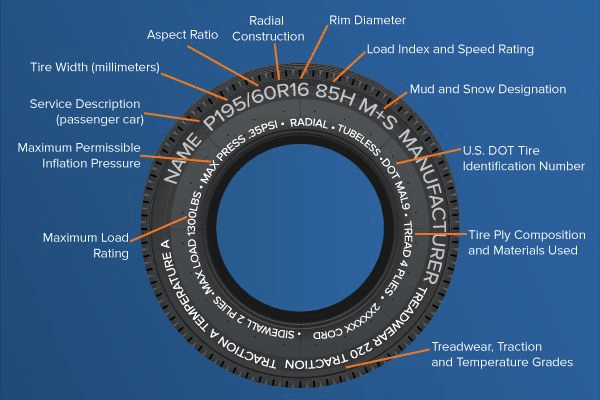
On the sidewall (the outer and inner sides) of a tire, you’ll find the following information:
Tire Specs– Size, construction and speed rating. Speed rating is the approximate speed a tire can safely maintain over time. The higher the rating (A is the lowest and Y is the highest), the better the handling and control. However, a higher speed rating may result in a shorter tread life. Check with your carmaker for the proper speed-rated tire for your model.
Department of Transportation Safety Code– This code certifies the tire manufacturer meets U.S. Department of Transportation tire safety standards. It is followed by your tire’s ID number, plus information about where and when the tire was manufactured.
Uniform Tire Quality Grading (UTQG)– The testing method used to grade a tire’s tread wear, traction and temperature.
Icons– Features a tire’s unique benefits. For example, “M+S” means the tire meets the Rubber Manufacturers Association standards for mud and snow.
How to read a tire’s sidewall
The diagram below shows where you’ll find this information on a tire.
Note the code on the sample tire above isP195/60R16 85H. The table below shows what each abbreviation in the code means.
P
Service Description P = “passenger car”LT= “light truck”ST = “special trailer”T = “temporary”
195
Tire Width Tire’s section width – distance from sidewall edge to sidewall edge. The higher the number, the wider the tire.
60
Aspect Ratio Tire’s section height compared to its section width. Lower numbers mean a short sidewall with improved steering & handling.
R
Internal Construction R = radial construction
16
Rim Diameter Wheel diameter, in inches, for which the tire was sized.
85
Load Index Measurement of how much weight each tire is designed to support. The larger the number, the higher the load capacity.
H
Speed Rating Speed the tire is designed to run for long periods.S = 112 mphT = 118 mphU = 124 mph
H = 130 mph
V = 149 mph
Z = Over 149 mph
W = 168 mph
Y = 186 mph
(Y) = Over 186 mph
Another factor to consider in buying tires istread-life warranty– an estimate based on the type of tire and the number of miles it can be expected to travel under normal driving conditions.
Types of tires
Now that you know tire terminology, consider the type of tire best suited for you and your car.
Type of Tire
Description
Speed Ratings
Tread-Wear Warranty (miles)
Best For
All-season tires
Cost-effective tires offer a smooth ride, long tread wear and adequate traction on dry and wet conditions
None, S, T
40,000 – 100,000
Cars and minivans
Older cars & climates that rarely drop below freezing temps
Performance all-season tires
Typically offer better handling and braking than regular all-season tires
H, V
40,000 – 60,000
Cars & minivans
Newer cars
Ultra performance tires
Provide good handling and steering in wet and dry conditions
ZR, W, Y
30,000 – 40,000
Cars & minivans
Upscale sedans or sports cars
Summer tires
The softer rubber provides maximum traction on dry and wet roads in warmer weather
—
—
Cars & minivans
Warmer climates
All-terrain tires
Best for paved roads and light-duty, off-road use
S
40,000 – 60,000
Light trucks & SUVs
Fit for most weather conditions – good for SUVs & other 4-wheel drive cars
Winter tires
Tread is designed for snow and ice; rubber can withstand freezing temps
Q, S, T
None
Areas that experience wintry conditions
Performance winter tires
Enhanced winter traction offers high-speed handling and higher levels of snow and ice grip
Q & up
None
Areas that receive an increased amount of snow and ice
When selecting tires, consider:
Weather conditions you commonly drive in
The worst weather situations you could expect to face
Where you usually drive – city streets, highways, etc.
Your driving style
Always make sure you select tires that are appropriate based on your owner’s manual and your tire distributor’s recommendation.
Here are some frequently asked questions about tires:
Common tire questions
What driving habits negatively impact a tire’s life?
Taking curves and corners fast
Abrupt accelerating and braking. This can cause excessive heat that wears the tire out more quickly
Hitting curbs, potholes, etc.
How do you extend the life of a tire?
In addition to driving responsibly, there are other ways you can prolong tire life:
Rotate tires regularly as outlined in your owner’s manual to help equalize tread wear
Check wheel alignment as recommended by your carmaker
What is the correct air pressure for your tires?
Find your optimal operating tire inflation pressure in the owner’s manual and on a sticker located on the inside of the driver’s door.
Can you mix tire types?
Performance is best when all 4 tires are the same size, tread pattern and age. Tires that vary in those factors can cause handling and stability problems. However, some cars have different size tires in the front and rear, so check your owner’s manual.
Can you mix tires with different speed ratings?
Generally, not recommended. It could affect handling and maximum speed limit.
When should you use winter tires?
Winter tires are generally used when the temperature remains consistently near freezing. Winter tires can provide improved grip on icy and snowy surfaces, and are one way you canprepare your car for driving in the snow.
Should winter tires be used only in snow?
Usually, if temperatures drop and you’ll be driving in rain, ice, snow or other wintery conditions. When temperatures stay above freezing, change to summer or all-season tires.
Can you use summer tires in the winter?
This is not usually recommended. Cold weather can cause softer summer tires to lose grip, develop cracks and shorten tire life.
Should you purchase used tires?
This is not typically recommended. You may be unaware of past hazards or mistreatment the tires underwent.
Choosing the right tires and knowing how to care for them is critical to safe driving. Get moretire safety tips, so you can keep yourself and your tires in top shape on the road.
Knowing how to clean your engine is an important part of vehicle maintenance, and it can save you money. Tidying up under the hood helps extend the life of belts, hoses and other components. Plus, it’s easier to spot leaks, tears and other damage on a clean engine. Check out the steps below to properly clean your car engine, and be sure to consult your car’s operation manual before you get started.
1. Eliminate any residue
Your car’s hood, grille and vents are prime areas for dirt buildup. Blow them out with compressed air or clean the areas with a wire hand brush.
2. Get the temperature just right
Next, let your engine warm up to a moderate temperature – not too hot. This will help soften grease buildup in the engine compartment.
3. Know what to cover when cleaning your engine
Plastic sandwich bags come in handy when it’s time to clean up your car. The parts to keep covered when cleaning your engine are:
Electrical wiring
Sensors
Spark plug openings
Alternator
Distributor
Secure the baggies with tape. To protect your battery, cover it or simply remove it.
4. Don’t forget the drip pan
Place old towels on an absorbent mat under the engine’s oil drip pan to catch any hazardous waste.
5. Give the engine a good spritz
Thoroughly spray the engine compartment with an engine cleaner, avoiding the wiring you bagged and taped. Since petroleum cleaners can damage rubber and vinyl components, consider a citrus or water-based degreaser. For parts that seem extremely oily or greasy, let the cleaner soak in for 15-30 minutes and repeat if necessary.
6. Rinse and unwrap
Once the engine cleaner has done its job, lightly rinse engine and components with water. Remove the bags you used to protect the wiring. Once the towel or mat is dry,dispose of it properly. And if you removed the battery, don’t forget to replace it.
7. Remove excess moisture
Blow away excess water in the engine compartment with compressed air.
8. Dry out the interior
Lastly, turn on your engine and let it run until warm. The heat will help dry the hard-to-reach areas.
Now that you know how to take care of your engine, check out ourcar maintenance checklistto help you keep your automobile in tip-top shape. But remember, protecting your vehicle isn’t just about regular inspections and cleaning schedules. Learn about howauto insuranceworks to keep you and your car safe on the road.
There are many factors that can cause tire wear, such as your driving style and tire maintenance habits. Tire replacement is absolutely needed when the tread wear indicators appear. Built-in tread wear indicators look like narrow strips of smooth rubber across the tread and become visible as the tire surface wears.